Best EP conveyor belt Manufacturers, Suppliers

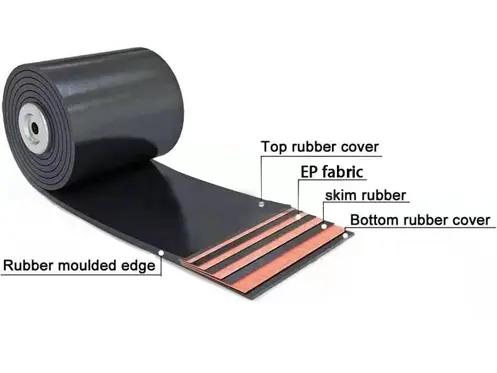
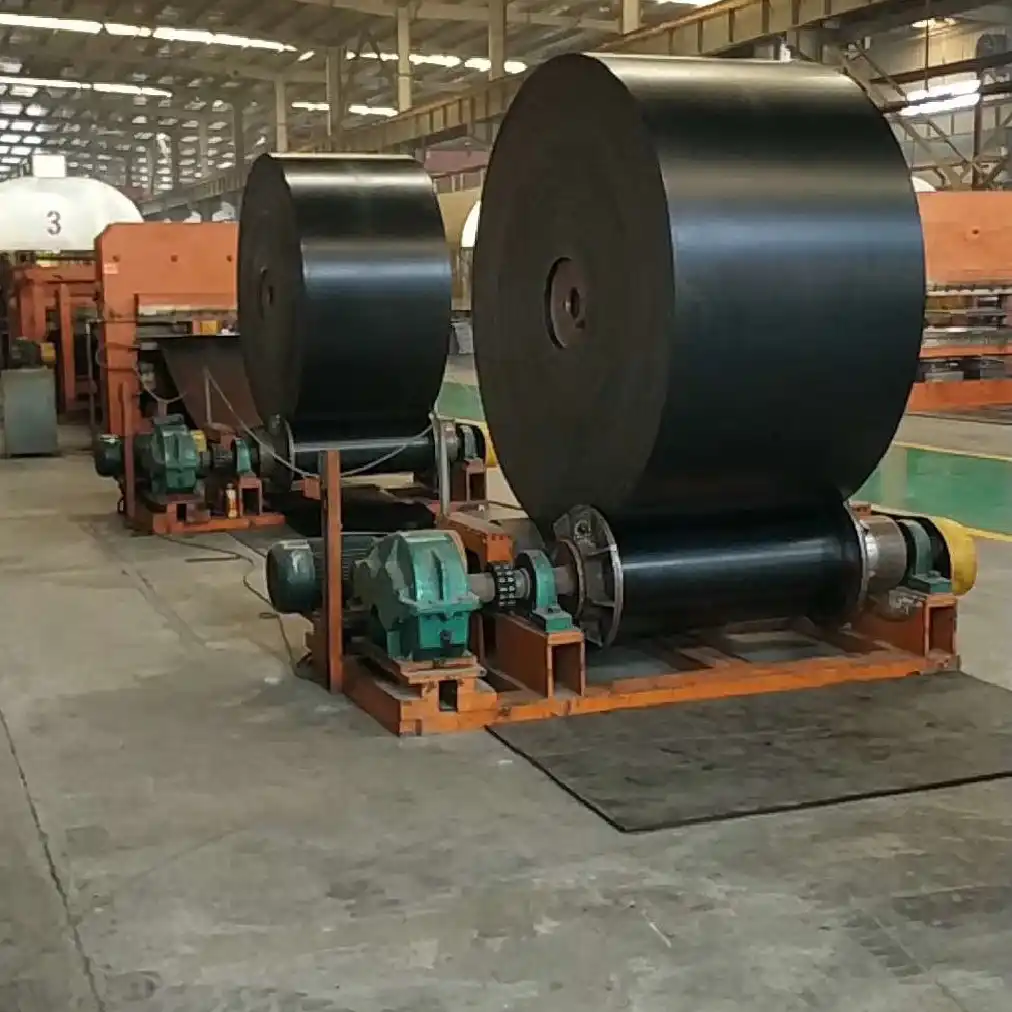
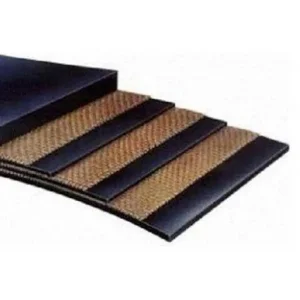
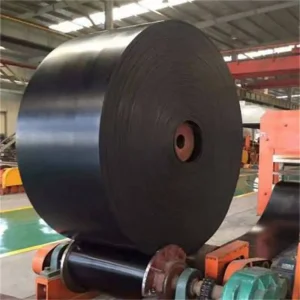
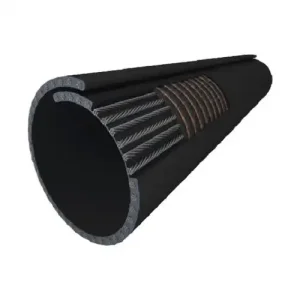
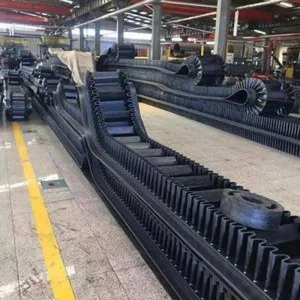
EP layered conveyor belts have high belt modulus and low elongation. The longitudinal reference force elongation rate of the full thickness is no more than 4%, which can reduce the tensioning stroke and the number of joints. They are impact-resistant, wear-resistant, corrosion-resistant, have good troughing properties and elasticity, and the belt body is soft, which can ensure smooth operation and no deviation. 

Product Description

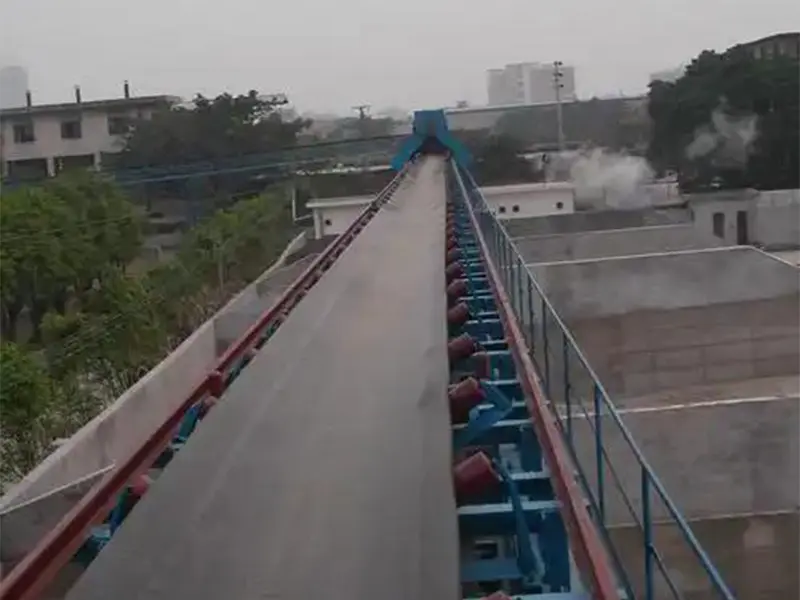
They have good heat resistance and heat stability, are moisture-resistant and insect-proof, have good dimensional stability, and are suitable for material transportation with large load, high speed and medium and long distance. The strength series of EP conveyor belts includes models such as EP100, EP125, EP150, EP200, EP250, EP300, and EP400. The values represent the longitudinal tensile strength of a single layer of canvas, and the unit is N/mm. When multiple layers are stacked, such as EP800/4, it means that the total strength of 4 layers of fabric is 800 N/mm.

The longitudinal tensile elongation at break of the full thickness shall not be less than 10%, and the longitudinal reference force elongation of the full thickness shall not be greater than 4%.

The average bonding strength between the fabric layers shall not be less than 4.5 N/mm, or shall not be less than 5 N/mm.

The bonding strength between the cover layer and the core layer shall not be less than 3.2 N/mm when the cover layer thickness is 0.8-1.5mm, and not less than 3.5 N/mm when the cover layer thickness is greater than 1.5mm; or shall not be less than 4.5 N/mm when the cover layer thickness is not greater than 1.5mm, and not less than 5 N/mm when the cover layer thickness is greater than 1.5mm.
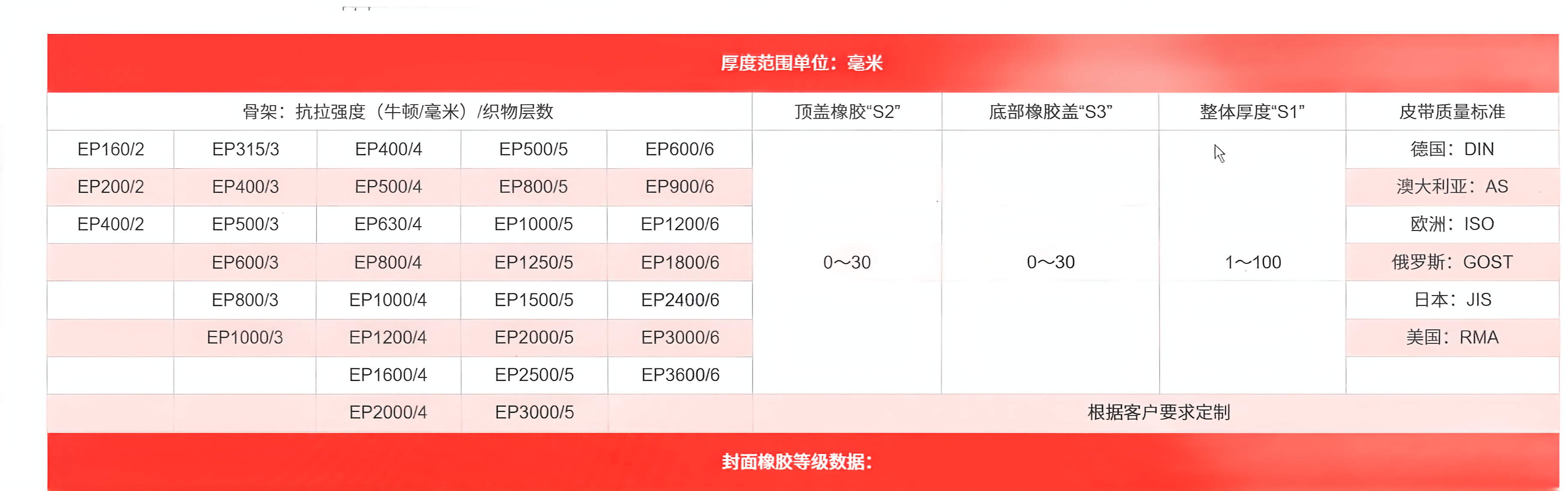
Cover Adhesive Performance Levels
Grade H
Strong scratch resistance: Requires a tensile strength of not less than 24 MPa, an elongation at break of not less than 450%, and an abrasion of not more than 120 mm³.
Grade D
Strong abrasion resistance: Requires a tensile strength of not less than 18 MPa, an elongation at break of not less than 400%, and an abrasion of not more than 100 mm³.
Grade L
General performance: Requires a tensile strength of not less than 15 MPa, an elongation at break of not less than 350%, and an abrasion of not more than 200 mm³.
The rate of change in tensile strength and elongation at break after aging for each grade is between -25% and +25%.
EP Conveyor Belt
Frequently Asked Questions (FAQ)
Q What are the main advantages and applications of EP conveyor belts?

EP conveyor belts feature excellent heat resistance, heat stability, moisture resistance, insect protection, and dimensional stability. They are ideal for high-speed, heavy-load, and medium-to-long-distance material transportation.

Q What do the model numbers like EP100 or EP800/4 represent?

The values (e.g., EP100, EP200) represent the longitudinal tensile strength of a single fabric layer in N/mm. A designation like EP800/4 indicates that the combined longitudinal tensile strength of its 4 fabric layers equals 800 N/mm.

Q What are the elongation specifications for these conveyor belts?

The full thickness longitudinal tensile elongation at break must not be less than 10%, while the longitudinal reference force elongation at full thickness should not exceed 4%.

Q What is the required bonding strength for the belt layers?

The average bonding strength between fabric layers must be at least 4.5 N/mm or 5 N/mm. For the cover-to-core bonding, it ranges from 3.2 N/mm up to 5 N/mm depending on the thickness of the cover layer.

Q How are the cover adhesive grades classified?

They are classified into three grades: Grade H for strong scratch resistance (tensile strength ≥ 24 MPa), Grade D for strong abrasion resistance (tensile strength ≥ 18 MPa), and Grade L for general usage (tensile strength ≥ 15 MPa).

Q How does aging affect the performance parameters of the cover adhesive?

After undergoing the aging process, the rate of change in tensile strength and elongation at break for all grades (H, D, and L) must remain within the range of -25% to +25%.
Related Products