7 Tips for Buying Fan Shaped Patterned Conveyor Belts

Time:2026-10-19 Author:Henry
0%

Buying Fan-Shaped Patterned Conveyor Belts is not simply a matter of choosing an attractive surface. The pattern must match the material, incline, belt speed, and working environment. A belt that grips wet gravel may perform poorly with fine powder. That difference matters.

R. Todd Swinderman, a recognized conveyor-safety specialist, has often emphasized, “Safety is not a priority; it is a value.” His principle applies directly here. Buyers should examine belt strength, cover quality, splice design, tracking behavior, and resistance to abrasion. They should also confirm the pattern height and spacing. These details affect cleaning, product stability, and energy use. Small errors become expensive quickly.

This guide introduces seven practical tips for selecting the right belt. It considers application conditions, supplier documentation, maintenance access, and total operating cost. Real purchasing decisions often involve imperfect information. A catalog may show a perfect belt surface, yet omit performance details under heat, moisture, or heavy loading. That gap deserves attention.

Look closely at the conveyor’s transfer points. Watch how material lands. Measure the actual incline instead of trusting an old drawing. Ask for test data when the application is unusual. A sample section can reveal surface hardness, flexibility, and pattern consistency. It is not a complete guarantee, but it is useful evidence.

The best choice is rarely the cheapest roll. It is the belt that remains stable, serviceable, and predictable over time. A careful evaluation can prevent slippage, premature wear, and disruptive replacement work. Still, no checklist replaces competent engineering judgment. That is the part buyers sometimes underestimate.
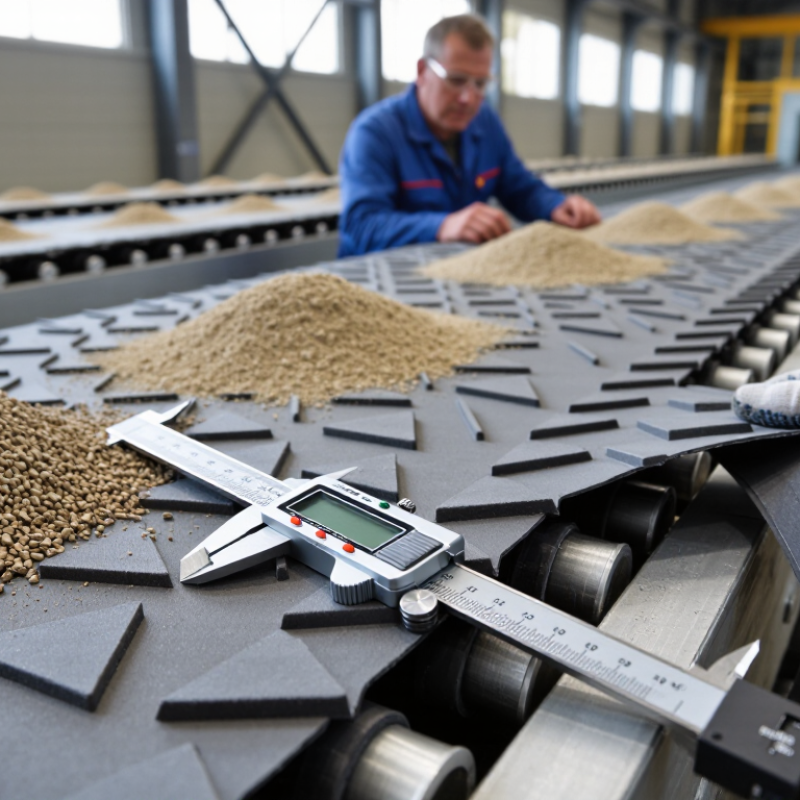
7 Tips for Buying Fan Shaped Patterned Conveyor Belts

Define Capacity, Width, and Speed Using CEMA Conveyor Design Data

Buying a fan-shaped patterned conveyor belt starts with material data, not the pattern. Record bulk density, lump size, moisture, temperature, and surcharge angle. Measure the material.

Use CEMA conveyor design data to estimate required capacity in tons per hour. Convert that capacity into a consistent mass-flow basis before selecting the belt. A practical calculation considers belt width, speed, trough angle, loading area, and material cross-section. Fan-shaped patterns can improve grip on inclined conveyors, but they do not automatically increase capacity. The pattern may also reduce effective cross-sectional space. Check it carefully.

Select width from the CEMA capacity tables, then verify the loading conditions. A narrow belt may spill material at the transfer point. An oversized belt can create unnecessary cost and poor cleaning performance. Speed needs equal attention. Higher speed may meet capacity targets, yet it can increase dust, impact, and mistracking risks. Lower speed may protect fragile materials but require a wider belt. Recheck it.

Leave room for variation. Material density can change between seasons, and wet feed often behaves differently from test samples. Confirm the design with actual feed-rate data when possible. Review pulley diameter, belt tension, splice requirements, and cleaning access with the supplier’s technical team. A simple field trial can expose problems that calculations miss. The first estimate is rarely perfect. That is normal.

7 Tips for Buying Fan Shaped Patterned Conveyor Belts

Define capacity, belt width, and operating speed using CEMA-style conveyor design data.

Capacity

Estimated carrying capacity increases with belt width and is shown in metric tonnes per hour.

Belt Width

Common widths from 450 to 1,200 mm provide practical options for light, medium, and heavy-duty conveying.

Operating Speed

The comparison uses a reference speed of 0.5 m/s, approximately 100 ft/min, with a 20° troughing angle.

The values are representative CEMA-style design references for a typical bulk material with approximately 20° surcharge angle. Final selection should also consider material density, lump size, incline, belt cover, loading conditions, and safety factors.

Match Fan-Pattern Height to Material Size and 20°–30° Inclines

When buying a fan-shaped patterned conveyor belt, match the pattern height to your material size. Small particles can settle between tall patterns and make cleaning difficult. Larger lumps need deeper profiles for better grip. A useful starting point is keeping the pattern clearly engaged with the material, without burying it completely.

For inclines between 20° and 30°, surface design becomes especially important. A shallow fan pattern may allow damp sand, grain, or crushed material to slide backward. A pattern that is too tall can disturb the material flow and increase carryback near the discharge pulley. Check the material’s moisture, bulk density, and average particle size before choosing the height. Test it under real loading conditions.

Do not judge the belt by appearance alone. Measure the incline, belt speed, and expected load. Then observe whether material rolls, bridges, or spills at transfer points. Small adjustments matter. In one trial, the selected pattern handled dry material well but performed poorly after rain. That mistake showed why seasonal conditions deserve attention. Ask for technical data on pattern height, traction, wear resistance, and minimum pulley diameter. Also inspect the belt after several operating cycles, because early wear can change how the pattern grips the load. A careful trial is often more reliable than a quick visual decision.

Verify Belt Construction Against ISO 14890 and DIN 22102 Standards

A fan shaped patterned conveyor belt can look suitable before its construction is properly checked. The surface pattern improves grip, but it also changes bending behavior, cleaning needs, and effective belt thickness. Verify the belt against ISO 14890 and DIN 22102 before comparing price or appearance.

Request technical documents showing the belt’s tensile rating, carcass design, cover thickness, rubber quality, and dimensional tolerances. Check whether the declared standard matches the belt type and intended service. Textile plies should be identified clearly, not hidden behind vague terms such as “heavy duty.” Measure the patterned top cover at several points, because raised fans can create misleading readings. Ask for batch-specific test reports when possible.

Inspect the belt edge and splice area carefully. Look for even ply alignment, clean bonding, and no exposed fabric. Confirm that the recommended pulley diameter suits the belt’s construction, especially where the pattern increases stiffness. A belt may satisfy a standard yet still perform poorly with sharp loading, abrasive material, or frequent reversing. That detail is easy to miss.

Use an experienced technician for acceptance checks. Photos help, but they cannot replace physical measurement. I have seen attractive patterns distract buyers from thin covers and uncertain documentation. That was avoidable. Recheck the specification against the conveyor’s load, speed, incline, and operating temperature before approval. Standards guide verification; they do not remove the need for practical judgment.

Compare Cover Abrasion Ratings Using ISO 4649 Test Data

7 Tips for Buying Fan Shaped Patterned Conveyor Belts

When buying a fan shaped patterned conveyor belt, cover abrasion deserves close attention. ISO 4649 test data provides a useful comparison through volume loss, measured in cubic millimetres. Lower volume loss usually indicates better abrasion resistance. However, test numbers can mislead when conditions differ. Check the applied force, sliding distance, test temperature, and sample preparation before comparing results.

Ask for the complete ISO 4649 report.

A patterned cover contacts material differently from a flat cover. Fan-shaped grooves may trap sharp particles, especially beneath heavy loads. Inspect the compound’s abrasion rating, cover thickness, hardness, and resistance to cutting. A thicker cover may improve service life, but it can also affect belt flexibility and pulley performance. The pattern is not the whole decision.

Field details matter.

In my experience, dusty stone and damp aggregate can wear the same belt in different ways. I once focused too heavily on an excellent abrasion figure and overlooked poor cleaning conditions. That was a costly assumption. Review the conveyed material, loading height, belt speed, scraper pressure, and conveyor alignment. Request test data from the exact cover grade, not a similar product. Check whether the laboratory sample represents the working cover. ISO 4649 data is valuable evidence, but it cannot predict every site condition. A practical trial or reference from a comparable conveyor can expose weaknesses that a laboratory number misses.

Check Splice Strength, Pulley Diameter, and a 10% Safety Margin

Buying a fan shaped patterned conveyor belt requires more than matching width and color. The pattern changes grip, loading behavior, and bending response. Start by measuring actual material flow, not only nominal conveyor dimensions. Record belt width, trough angle, conveyed weight, speed, temperature, and daily running hours. Small details matter. Check the fan pattern height against the product. A high profile can stabilize cartons, yet it may trap fines or increase cleaning time. Request technical data for cover hardness, tensile strength, and operating temperature. Do not rely on photographs alone.

Splice strength deserves direct attention. Ask how the joint is made and what tested strength remains after installation. A splice should tolerate repeated flexing over the smallest pulley, not only a one-time pull test. Compare the recommended minimum pulley diameter with every drive, tail, and bend pulley. Measure worn pulleys too. They are often overlooked. If the conveyor has frequent starts, reversing, or heavy impact loading, choose a design with at least a 10% safety margin above calculated tension. This allowance covers acceleration, uneven loading, and normal wear. It cannot correct poor alignment.

Inspect tracking guides, pulley lagging, and edge clearance before ordering. Fan shaped patterns can create uneven contact when the frame is misaligned. Request installation guidance, splice tools, inspection intervals, and test records from qualified technical personnel. A trial section under real load can reveal noise, slippage, or pattern wear. Document every assumption. Calculations fail when one loading peak is missed. Recheck them after two weeks of operation.

FAQS

What material data should be collected before selecting a patterned conveyor belt?

Record bulk density, lump size, moisture, temperature, and surcharge angle. Measure the material directly.Small errors matter.Wet material may behave differently from dry test samples.

Does a fan-shaped pattern automatically increase conveyor capacity?

No. The pattern may improve grip on inclined conveyors, but it can reduce usable cross-sectional space.Check the loaded belt carefully.

How should belt width be selected?

Use conveyor capacity tables with the required tons-per-hour figure. Then verify loading and transfer conditions.A narrow belt may spill material. An oversized belt may cost more and clean poorly.

How does belt speed affect conveyor performance?

Higher speed can meet capacity targets, but it may increase dust, impact, and mistracking.Lower speed may protect fragile material. It may require a wider belt.Recheck the balance.

What abrasion information should be requested?

Request complete laboratory test data showing volume loss, applied force, sliding distance, temperature, and sample preparation.Lower volume loss usually suggests better abrasion resistance. It is not a complete field prediction.

Why should the cover compound match actual site conditions?

Sharp particles may lodge inside fan-shaped grooves under heavy loads. Dusty stone and damp aggregate can cause different wear.Review cover thickness, hardness, cutting resistance, speed, scraper pressure, and alignment.

What should be checked about the splice and pulleys?

Confirm the splice method and its tested strength after installation. It must tolerate repeated flexing.Compare the recommended minimum pulley diameter with every drive, tail, and bend pulley.Worn pulleys need attention too.

When is a safety margin useful?

Use at least a 10% margin above calculated tension for frequent starts, reversing, impact, or uneven loading.It cannot fix poor alignment.

Why is a field trial valuable before full installation?

A loaded trial can reveal slippage, noise, tracking problems, cleaning difficulties, or rapid pattern wear.Laboratory figures are useful.The first estimate is rarely perfect. That is normal.

Conclusion

Choosing Fan-Shaped Patterned Conveyor Belts requires more than comparing surface designs. Begin by defining the required capacity, belt width, and operating speed with CEMA conveyor design data so the system can handle the intended material flow efficiently. For inclined conveying, select a fan-pattern height that matches the material size and supports stable movement on slopes of approximately 20°–30°. The pattern should improve grip without creating unnecessary material buildup or cleaning difficulties.

Before purchasing, verify that the belt construction aligns with ISO 14890 and DIN 22102 requirements. Compare cover abrasion resistance using ISO 4649 test data, giving preference to materials suited to the expected workload and environment. Also review splice strength, minimum pulley diameter, and the belt’s ability to tolerate repeated bending. Finally, include at least a 10% safety margin when evaluating tensile capacity and operating conditions. A careful review of these factors helps ensure reliable conveying, longer service life, and safer overall equipment performance.


Henry

Henry

Henry is a dedicated marketing professional with a profound expertise in the company's offerings. With years of experience in the industry, he possesses an impressive understanding of the market dynamics and consumer behaviors that drive success. Henry is committed to sharing his insights through......