Choosing the right conveyor belt can shape production speed, product protection, and maintenance costs. Granular Patterned Conveyor Belts are designed for materials that need controlled movement across inclined or horizontal systems. Their textured surfaces can improve grip when handling grains, seeds, powders, aggregates, and packaged goods.
This guide examines seven strong options for global buyers. It considers pattern depth, belt composition, tensile strength, cleaning needs, and temperature resistance. These details matter on a dusty quarry line or inside a food-processing plant. A belt that performs well in one environment may fail in another. That is easy to overlook.
The selection also considers supplier transparency, customization support, delivery reliability, and documented testing. Experienced buyers should request technical datasheets, sample specifications, and clear warranty terms before ordering. Visual appearance alone proves very little. A deep pattern may increase traction, yet it can complicate cleaning or retain fine particles. A smoother surface may clean faster but slip under steep angles.
Real operating conditions should guide every comparison. Consider conveyor width, pulley diameter, belt speed, load weight, ambient temperature, and material abrasiveness. Local service availability can matter as much as the initial price. Some recommendations may suit heavy-duty industrial use, while others fit lighter commercial systems. There is no universal winner.
The following overview presents seven practical choices and explains where each belt may perform best. It also highlights limitations, because reliable purchasing depends on honest evaluation. Small details often decide long-term value.
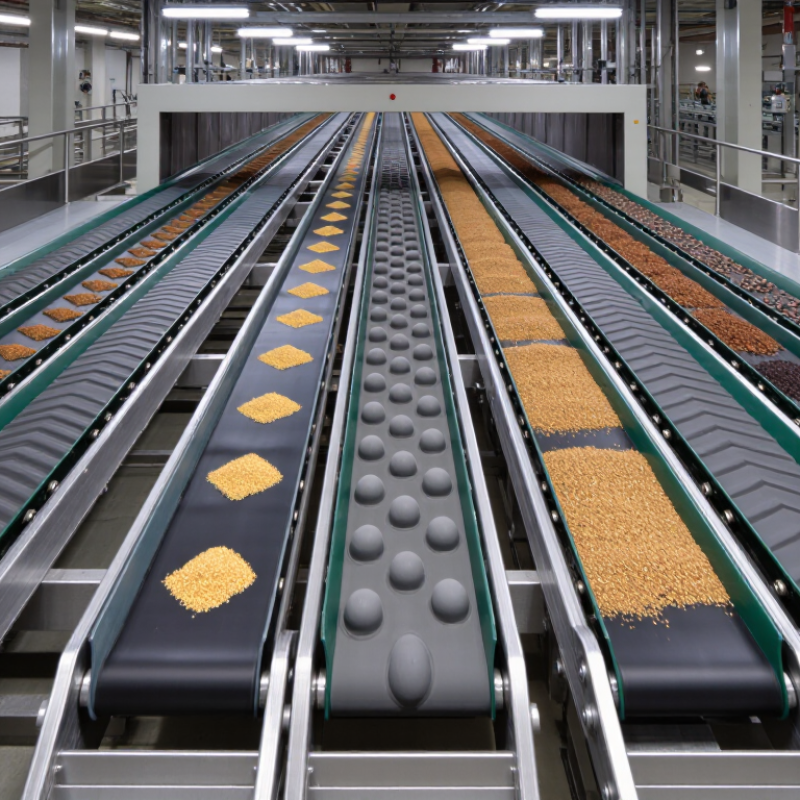
Granular conveyor belts carry sand, grain, pellets, and crushed stone under demanding conditions. Their pattern controls grip, spillage, and cleaning effort. Chevron, herringbone, and raised-rib profiles suit different inclines. Deep chevrons hold damp aggregate better, while shallow ribs reduce carryback on dry powders. Sometimes, the deeper pattern looks safer but increases trapped material.
ISO 14890 defines requirements for rubber and plastic-covered conveyor belts used in general surface conveying. It addresses dimensions, construction, tensile performance, adhesion, and abrasion-related properties. It does not select the best profile for every granular product.
Material choice still matters. Rubber handles impact and sharp stone well; PVC offers a clean, flexible surface; polyurethane can resist oils and fine abrasion.
MarketsandMarkets projected the global conveyor belt market to grow from about USD 5.3 billion in 2023 to USD 6.6 billion by 2028, a 4.5% compound annual growth rate. That growth reflects expanding bulk-material handling, not automatic suitability for every belt.
Buyers should check belt width, trough angle, lump size, moisture, temperature, and loading impact. A practical site trial remains valuable. Catalog data can miss reality. Poorly matched profiles often increase dust, noise, and maintenance, even when the belt meets ISO 14890.
Selecting a granular patterned conveyor belt depends on material size, moisture, loading rate, and incline angle. The seven most practical types are fine diamond, raised rib, herringbone, V-cleat, chevron, crescent cleat, and deep-pocket patterns.
Fine diamond surfaces suit dry granules on 18° inclines, with low cleats and pitches near 20–30 mm. Raised ribs offer steadier tracking for small pellets, usually at 18–20°. Herringbone patterns improve grip when dust reduces contact, but cleaning becomes less convenient. V-cleats, around 15–25 mm high, handle moderate loads at 20–23°. Chevron belts normally use 20–30 mm cleats and 30–60 mm pitches for inclines near 25°. They resist rollback better than plain textured belts.
Crescent cleats provide repeated pockets for uneven granular flow, often working around 25–28°. Deep-pocket patterns give the strongest hold for steep 28–30° conveying, especially with damp or irregular granules. Higher cleats are not automatically better. They can increase carryback, spillage, and belt-cleaning demands. In field trials, I check the actual material angle, not only the catalog rating. A belt that performs well with dry grain may slip with fine powder. That detail is easy to miss. Load tests should measure grip, discharge cleanliness, belt tracking, and wear after repeated cycles. Minor adjustments in pitch can change performance significantly.
Typical selection data for granular, bagged, boxed, and moderately cohesive bulk materials. Actual performance depends on material moisture, particle size, belt speed, loading method, and conveyor design.
| Rank | Belt Type / Surface Pattern | Typical Belt Construction | Cleat Height | Cleat or Pattern Pitch | Relative Grip | Recommended Incline | Suitable Materials or Products | Main Selection Advantage |
|---|---|---|---|---|---|---|---|---|
| 1 | Chevron Cleated Belt, 15°–25° V-Pattern | PVC or rubber cover with molded V-shaped transverse cleats | 15–25 mm | 250–400 mm | High | 18°–30° | Gravel, sand, fertilizer, grain, wood chips, and boxed goods | Provides effective forward traction while allowing material to move through the central trough area. |
| 2 | Herringbone Patterned Belt | Textured PVC or PU belt with repeated directional herringbone ribs | 3–8 mm surface relief | 30–60 mm pattern repeat | High | 18°–25° | Cartons, sacks, packaged food, agricultural products, and small granules | Combines good grip with a relatively smooth conveying surface and easy product release. |
| 3 | Raised-Rib Cleated Belt | PVC or rubber belt with straight transverse ribs or low-profile molded bars | 8–15 mm | 100–200 mm | Medium–High | 18°–25° | Grain, pellets, seed, bags, parcels, and light bulk materials | Offers a balanced combination of load retention, low noise, and moderate cleaning requirements. |
| 4 | Diamond-Top Patterned Belt | Oil-resistant PVC, PU, or rubber belt with embossed diamond texture | 2–5 mm surface relief | 20–50 mm diamond repeat | Medium–High | 18°–22° | Cartons, plastic containers, bags, light granules, and general material handling | Provides multidirectional grip and stable package handling without tall cleats. |
| 5 | Deep-Cleat Pocket Belt | Rubber or PVC belt with transverse pockets and raised side containment | 25–40 mm | 300–500 mm | Very High | 22°–30° | Coal, crushed stone, compost, wet aggregates, and irregular bulk solids | Retains larger or heavier loads effectively on steep inclines and reduces rollback. |
| 6 | Rough-Top Granular Belt | Rubber or PVC cover with fine granular, sandpaper-style surface texture | 1–3 mm surface relief | Continuous texture; no regular cleat pitch | Medium | 18°–20° | Dry powders, small bags, cardboard cartons, paper products, and lightweight granules | Delivers gentle, continuous traction where tall cleats could damage or disturb the product. |
| 7 | Mini-Cleat Cross-Rib Belt | Thermoplastic belt with closely spaced low transverse ribs | 4–8 mm | 40–80 mm | Medium–High | 18°–25° | Small parts, seed, pellets, food ingredients, parcels, and shallow-layer loads | Improves traction for small products while maintaining a flexible belt profile and easy discharge. |
PVC, PU, and Rubber Options Compared by Tensile Strength and Abrasion Data
For granular materials, surface grip matters as much as belt strength. Seven practical choices include fine-rough PVC, deep-rough PVC, patterned PU, cleated PU, diamond-pattern rubber, chevron rubber, and heavy-duty rubber with embedded fabric.
Fine-rough PVC suits dry grain and light minerals. Its tensile ratings commonly range from 315 to 800 N/mm.
Patterned PU often offers cleaner handling and strong abrasion resistance, although its tensile rating may sit between 250 and 600 N/mm.
Rubber belts handle sharper aggregate and heavier loading. Many reinforced grades reach 800 to 2,000 N/mm tensile strength.
Their abrasion loss may fall below 150 mm³ under DIN-style testing, while ordinary PVC can reach 150–250 mm³. Lower loss usually means longer service. Not always.
Moisture, pulley diameter, loading impact, and trapped dust can change the result quickly. Chevron rubber gives better incline control, but its raised pattern may collect sticky fines.
Field trials remain essential. I have seen a high-rated belt fail early because the transfer point dropped material too aggressively. That detail was missed during selection.
Buyers should request tensile data, abrasion results, cover hardness, and splice guidance from the supplier.
Compare test methods carefully. A number without its standard is incomplete.
Short samples help. They reveal noise, slippage, cleaning difficulty, and edge wear before a full installation.
Granular patterned conveyor belts can improve grip when carrying flour, grains, vegetables, or packaged food. For global buyers, food contact compliance must guide the selection. FDA 21 CFR 177.2600 applies to certain rubber articles intended for repeated food contact. However, a belt is not automatically compliant because it uses “food-grade” rubber. The full belt structure, coatings, adhesives, and operating conditions require review.
In the European market, Regulation (EC) No 1935/2004 requires food-contact materials to avoid harmful substance transfer. It also requires traceability and suitable use under expected conditions. Ask for a current declaration of compliance, test reports, migration data, and material composition. Check temperature, contact time, food type, cleaning chemicals, and belt speed. A rough granular surface can trap dough or oil. That detail matters during sanitation inspections. In practice, suppliers may provide incomplete documents. Buyers should verify batch records instead of trusting a certificate alone.
Tips: Request samples before approval. Run a trial with the real food product and cleaning routine. Inspect seams, edges, and patterned pockets after repeated washing. Confirm whether the FDA reference covers the finished belt or only its rubber compound. For EU use, request documentation supporting the intended food category and operating conditions. I would also record surface wear during testing, because a belt may perform well initially but release particles later.
For global buyers, a granular patterned conveyor belt should be evaluated against the material, not its appearance. Iron ore production reached about 2.5 billion metric tons in 2023, according to the USGS Mineral Commodity Summaries 2024. Such volumes demand verified load calculations. Check belt width, carrying capacity, trough angle, speed, bulk density, and impact energy together. A wider belt is not automatically safer.
Pattern height matters. Deep profiles can improve grip on inclined conveyors, but they may increase cleaning difficulty and material retention. Confirm the actual capacity in tonnes per hour. Request test data for tensile strength, pulley diameter, splice performance, and abrasion resistance. The World Steel Association reported 1,888.2 million tonnes of crude steel production in 2023, showing why reliable bulk handling remains commercially important. Still, reported capacity can be optimistic.
Temperature selection needs equal care. Measure material temperature at loading, transfer, and shutdown, not only in the process specification. Short heat spikes can damage a belt faster than a stable lower temperature. For textile conveyor belts carrying bulk materials, verify conformity with the applicable DIN 22102 requirements and obtain traceable inspection records. Check cover grade, adhesion, belt construction, and test dates. DIN compliance alone does not prove suitability for every granular product. Moisture, sharp particles, and repeated impact can change the result. Buyers sometimes overlook this. Recheck the calculation with actual site samples before ordering.
Typical maximum conveying angle for granular materials by belt pattern
Chevron, cross-rib, and multi-chevron patterns generally provide the strongest grip for steep conveying of bulk solids. Actual performance depends on material size, moisture, loading rate, belt speed, and cleat geometry. Confirm belt construction, temperature limits, load capacity, and documented DIN 22102 conformity before purchase.
| Pattern | Typical granular application | Common width range (mm) | Typical operating temperature (°C) | Typical load class | DIN 22102 check |
|---|---|---|---|---|---|
| Chevron | Coal, gravel, sand, stone | 400–1800 | −25 to 80 | Medium–heavy | Verify documentation |
| Multi-chevron | Wet aggregate and bulk minerals | 500–2000 | −25 to 80 | Medium–heavy | Verify documentation |
| Cross-rib | Grains, fertilizer, packaged bulk goods | 400–1600 | −25 to 80 | Light–medium | Verify documentation |
| V-pattern | Sand, pellets, grain, crushed material | 400–1800 | −25 to 80 | Medium | Verify documentation |
| Diamond | General bulk handling and recycling | 400–1600 | −25 to 80 | Light–medium | Verify documentation |
| Rough-top | Dry powders and light granular products | 300–1400 | −20 to 70 | Light | Verify documentation |
| Herringbone | Gravel, grain, and moderately inclined conveying | 400–1800 | −25 to 80 | Medium | Verify documentation |
They carry sand, grain, pellets, crushed stone, and similar bulk materials. Moisture and particle size matter.
Chevron, herringbone, and raised-rib patterns improve grip on inclines. Deep patterns hold damp aggregate better. They may trap more material.
Shallow ribs often reduce carryback on dry powders. Fine dust can still collect near edges and splice areas.
Rubber suits sharp stone, heavy loading, and strong impact. Reinforced grades can provide high tensile strength. The belt may still wear early if loading is aggressive.
PVC offers a flexible, relatively clean surface for dry grain and light minerals. Polyurethane can resist oils and fine abrasion. Neither option fits every site.
Compare belt width, trough angle, lump size, moisture, temperature, and loading impact. Review tensile strength, abrasion results, hardness, and splice guidance.
No. A standard can address dimensions, construction, tensile performance, adhesion, and abrasion properties. It does not choose the best profile for your material.
Catalog data can miss transfer-point impact, noise, slippage, and cleaning problems. Test a short sample with real material. Reality can disagree.
Request current compliance documents, migration data, material composition, and batch records. Check the finished belt, not only its rubber compound.
Run repeated washing with the actual cleaning routine. Inspect seams, edges, and patterned pockets. Record wear, because later particle release may be missed.
Granular Patterned Conveyor Belts are designed to move loose, granular materials securely across horizontal and inclined conveying systems. Their surface patterns, cleat profiles, spacing, and grip levels help reduce rollback and improve material stability, especially on inclines between 18° and 30°. This guide explains how belt structure, profile height, pitch, tensile strength, and abrasion resistance affect performance, while comparing PVC, PU, and rubber constructions for different operating environments. It also introduces key considerations related to ISO 14890 and DIN 22102.
For food-handling applications, buyers should verify that belt materials and manufacturing processes meet applicable requirements, including FDA 21 CFR 177.2600 and EU Regulation 1935/2004. A practical global purchasing checklist should cover load capacity, belt width, operating temperature, cleaning conditions, splice design, service life, and compliance documentation. By matching these factors with the required grip and conveying angle, buyers can select a durable, hygienic, and reliable granular conveyor solution.

Boao Rubber